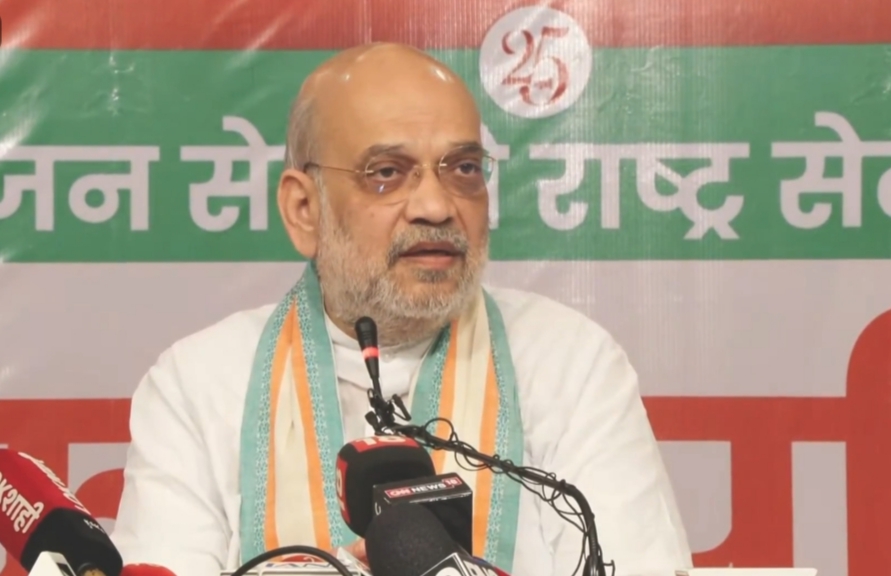
Amit Shah Says J&K Fully Integrated With India, UCC to Be Extended Across NDA-Ruled States
Mumbai, September 14 (ANB): Union Home Minister Amit Shah on Sunday said Jammu and Kashmir is now fully integrated with the rest of India, asserting that the abrogation of Articles 370 and 35A was carried out without bloodshed or the firing of a single bullet.
Addressing reporters in Mumbai, Shah highlighted what he described as key achievements of the Central Government under Prime Minister Narendra Modi, covering Jammu and Kashmir, counter-terrorism, the Uniform Civil Code (UCC), Left-Wing Extremism, the Northeast, criminal justice reforms, illegal infiltration and the campaign against drugs.
UCC Expansion Planned Across NDA-Ruled States
Shah said the Uniform Civil Code would be implemented in all 21 states governed by the BJP-led National Democratic Alliance before 2029.
He said the UCC had already been introduced in some states and that efforts were underway to extend it to other NDA-ruled states ahead of the next Lok Sabha elections.
The Home Minister also referred to the abolition of triple talaq, stating that the measure had strengthened the rights of Muslim women.
Shah Calls Article 370 Abrogation a Major Milestone
Speaking about Jammu and Kashmir, Shah described the abrogation of Articles 370 and 35A as a significant achievement of the government.
He said the constitutional changes were implemented without bloodshed and asserted that Jammu and Kashmir had subsequently become fully integrated with the rest of the country.
Shah linked the decision to the government's broader approach towards national security and its stated objective of strengthening India's territorial and constitutional unity.
Government Reaffirms Zero-Tolerance Approach to Terrorism
The Home Minister reiterated the Centre's zero-tolerance policy towards terrorism, citing the surgical strikes, air strikes and Operation Sindoor as examples of India's response to terror threats.
He said these operations reflected the government's resolve to safeguard national security and respond firmly to attacks against the country.
Shah Highlights Government's Action Against Naxalism
Shah also outlined the government's efforts to combat Left-Wing Extremism, claiming that five decades of Naxalism had been brought to an end.
He said the Centre had signed more than 14 peace agreements in the Northeast and that over 9,000 people had surrendered.
According to Shah, these measures had contributed to greater peace, stability and development in the region.
Criminal Justice System Undergoing Structural Reforms
Highlighting changes in the criminal justice system, Shah said the implementation of the Bharatiya Nyaya Sanhita had strengthened India's legal framework.
He claimed that several states had witnessed an increase of nearly 30 per cent in conviction rates within a single year.
Shah also said the government was working towards developing a system under which justice could be delivered within three years.
Centre Holds Consultations on NRC in Manipur
On the proposed National Register of Citizens in Manipur, Shah said the Centre was holding consultations with its allies and political parties in the state.
He said a final decision would be taken after the consultation process was completed.
Deportation of Illegal Infiltrators to Continue, Says Shah
Responding to questions about the identification of alleged illegal Bangladeshi infiltrators, including in Mumbai, Shah said the government would not disclose the methods being used for their detection.
He reiterated the Centre's position that illegal infiltrators would be identified individually and deported in accordance with the law.
Anti-Drug Campaign to Be Strengthened at Grassroots Level
Shah also highlighted the government's Nasha Mukt Bharat Abhiyan, saying he would visit different states as part of efforts to strengthen the nationwide campaign against drug abuse.
He emphasised the need to take the campaign to the grassroots and expressed confidence that the country would ultimately overcome the challenge posed by drugs.
Shah's remarks covered a range of issues, including Jammu and Kashmir, national security, terrorism, the Uniform Civil Code, Naxalism, the Northeast, criminal justice reforms, illegal infiltration and the campaign against drugs.
(ANB)
|